Chapter 7
Even with all the help and support we were receiving; time was running out and fresh challenges were arising all the time.
But we needed to recognise that these were just challenges that could be dealt with if we were willing. We had not expected it to be easy – and challenges should help each one of us to improve what we are doing and as we would be needed to make the right changes for future use, to grow as well. It was not getting any easier – but it was still well worthwhile and we should have been expecting this as nothing really worthwhile is ever going to be easy. We needed to persevere and not give up for everyone’s sake including our own!
H’s Role Confirmed
We managed to sort out and agree a new grievance procedure to quieten things down and applied for a new foreman but at that time we also raised the matter of ‘H’ with the MSC where relationships continued to be positive. They agreed with us on the value ‘H’ had become to the team and know that he was married, they ‘bent the rules’ and added him to the payroll as our Technical Foreman for the remainder of the project. This meant that he was able to start married life on a secure basis and at the end of the project, he was them able to join the full TCW programme benefitting from a wider experience before going on himself to pastures new.
JCP Six monthly report
When we had been operating for 26 weeks – at the end of September 1977 we sent the following report to the JCP with our monthly returns.
We have a new supervisor and a new trainee starting Monday. Our labour supervisor resigned because he is emigrating to Canada at the end of this week.
We are still having great difficulty in attracting the right kind of supervisor or craftsman although we are now allowed three men on the top rate and three craftsmen at a slightly lower rate. The rest of our workforce of 15 are trainees - young lads, many, if not all, unaccustomed to work and discipline of a building site. Our craftsmen find it difficult to relate to more than one or two, and then only in specialised trades, so our general foreman, technical supervisor and works supervisor are not finding it easy to keep the standard of work up to a very high standard. Some jobs are having to be undone because simple instructions have not been carried out correctly and insufficient of the boys have the opportunity of working alongside a skilled craftsman.
A high degree of personal involvement with the lads and their problems is necessary. At least three are completely illiterate and more than half the rest are only semi-literate. Seven express an interest in attending college and three I think will make it through the day release courses being offered. Others have been linked up with evening classes, for practical skills and adult literacy sessions. About 50% of the labour force have been in trouble at some time or other - most of this we were aware of before we took them on. One lad, who had been dismissed from his previous employment had proved a good workman on the site, but he did not let us know when he had to attend Court, firmly believing that he would be found innocent. He was sent to a detention centre for three months for a first offence. We have managed to support his family and will be happy to re-employ him if there is a vacancy at the time of his release.
We're trying hard to encourage the youngsters to search for other employment of a more permanent nature, but this they are loathe to do and the openings are few. Those who do leave voluntarily do so because they have found jobs in another area rather than Newham. Any help along these lines would be much appreciated.
These are just a few of the problems. Even so, progress is being made, although not at quite the rate we would hope.
This was part of our reciprocal help in preparing for future planning of Government grants resulting in other correspondence during this period. A ‘problem shared’ is a ‘problem halved’ and we were now highlighting problems we had experienced that they would need to plan for in future funding programmes. Hopefully we were also fulfilling this aspect of the cooperative venture.
Building a Team at Different Levels
Although the JCP programme had been initially set up to provide employment for those who were not able to get jobs primarily for lack of training or experience, we were always grateful to be able to employ the two slightly more highly paid levels of worker who also had to be taken from the unemployment register. Those who brought specific building skills with them served us well by getting on with their own crafts and especially if they were willing and able to take one or two lads under their wing, although we soon found that threesomes were too much of a problem. Although most craftsmen were willing to take some responsibility for others it did slow them down a little and meant that the work took longer, but it was a great help in teamwork.
Importance of Capable Supervisors
But so far, our experience of taking on unemployed supervisors had been limited to just two – ‘Ben’ and ‘Alex’. With ‘Alex’s departure after six months, ‘H’ was also added to the payroll and at this point we were also fortunate to be able to employ ‘Bert’ who was somewhat older, had had training and experience and was not far off retirement. He became our new ‘works foreman’ settling in reasonably easily into our structure alongside ‘Ben’ who had stuck with us and served us well from the beginning. ‘Bert’ was able to stay and served us well for a further four months during which time he took full site control when in week 36, ‘Ben’ eventually had also suddenly stopped coming as his wife had been taken ill and he had found the additional pressure too much. Numerous letters, phone calls and attempts were taken to discover how we could help, and Herbie took over these efforts on a pastoral level.
But it did eventually enable us to employ ‘Ken’ to join the remaining supervisory team in week 33 and he coped well with adapting events leading to the conclusion and we were then able to give him excellent references when he applied to become both a Barking Education Welfare Officer and also as a British Rail Supervisor. I am not sure which job he eventually took but I think he was offered them both! But we counted our blessings that we had such consistency at the supervisor level with ‘Ben’, ‘Alex’, ‘H’, ‘Bert’ and ‘Ken’ - the five who served us so well through the major part of the project and then ‘Kurt’ who came on board at the end to see us through the last few weeks to round the programme off..
Importance of Enabling Craftsmen
Our project emphasised not just the need for efficient coordinators and supervisors but also the need for employing a number of different skilled craftsmen to come on board at the right time. These also needed to be willing to be not only doers, but also enablers – with the willingness to pass on their skills and to teach others.
Towards the end of the project as the time available grew less, finding those who enjoyed teaching others rather than just getting on with the job themselves was more difficult. There were times when we did not need to have an electrician, a carpenter or a plumber sitting around with nothing to do, especially if he was not willing to diversify.
Importance of Labourers Willing to Train
Unfortunately, also, not all unemployed young people had a mindset to want to work, and these often took advantage of any unrest that others may have instigated, and then made the situation worse by putting more pressure on the supervisors. As we have already said more than one lad we interviewed had started with the mindset ‘I need a job, but I don’t want to work!’. Then we also often had to work hard to get them to consider training for an occupation that would open doors and give them more opportunities.
Things had certainly improved a little when we changed jobs around and took on young ‘Shane’ as our regular teaboy and ‘gofer’ which was a role that suited him well – but he had gifts that could not be fulfilled on a building site - more about him later.
As sponsors, we needed to do our best to discover any talents and help each employee achieve their potential. We did our best to help in the limited time they were with us, when any enthusiasm was shown, no matter what it was for – and we often needed to help them purchase their own tools for the trade for which they were training, so we followed their progress with great interest.
Importance of Commitment
We worked hard to generate an interest in the whole project with those who accepted the posts being offered – however short a time these tended to be. Very few, in fact, came onto the site with the feeling that it was just another job. Most caught the sense that they were creating something, they were not just working for themselves and although there was pilfering on the site, it was of a very minor nature. There were rewards for them that were not just money. Most were encouraged to receive a sense of satisfaction from seeing the job well done and completed and also of learning. Those around at the time, all signed the notice board at the first Open Day to say that they had worked on the site. They were proud to feel that they belonged and so they protected their property.
The boys did also make an effort at the time of centre occasions. Some even turned up to help at Jumble Sales to raise money for the materials. I think it is probably true to say that most were genuinely interested in the purpose of the whole rebuilding operation. In fact, this was one of the great things the longer people stayed – commitment to the purpose of the project.
Extension
By November 1977 as we reached week 36 of our 45 week programme, we had to report that we had "moved from being overstaffed to understaffed with an unexpected turnover of personnel”. Five men had been dismissed during the month, three more had found jobs, plus the site foreman just mentioned who had had personal problems and so had stopped coming. Although adjustments had been made and new personnel appointed, an extension of time was applied for and verbal agreement was given for an extra twelve weeks to the end of April as we still had some staff funding in hand.
The House Committee, having faith that all would be completed and believing they could then at last celebrate, also began to plan for a grand reopening of their extended facilities for the 2nd week in May 1978.
Social Hazards
Socially, the mid-70s was a time of national unrest with break-ins and vandalism increasing particularly throughout our area. Strangely though there was only one occasion when the building site itself was subject to a break-in. Entrance had been gained through the site on two or three occasions, or escape was made that way, but no damage was ever done to the side of the building that was being rebuilt. The only break-in onto the building site of any consequence was one morning when we found that a tramp had obviously been sleeping in one of the newly constructed rooms and had had a couple of bottles of spirits with him. He left behind more than he took away with him, but the damage was not too long in being repaired and the insurance paid up almost immediately.
Anything left unguarded outside was often seen as ‘fair game’ – even if these happened to be bikes that were chained up – so careful watch needed to be kept but if there were any actual break-ins, the target was usually the Renewal Programme offices on the first floor over the community hall which now fully occupied attracted quite considerable numbers of visitors and much traffic throughout the day, including our own workforce – although we rarely had reason to even suspect that they might have been involved in any way.
When either a door or window had been broken to gain entry, it was usually just vandalism. But there was one occasion when we didn’t discover that a fire had been smouldering all Sunday in the general office while we had been holding Christingle services downstairs in the hall below with many people around throughout the Sunday. God certainly must have been watching over everybody there, because the fire just put itself out and there was just a mass of ash when it was discovered the following morning.
All sorts of things had been thrown onto the fire and the duplicator and the offset litho machine were damaged beyond repair. The amazing thing was that the fire stopped inches short of a whole battery of inks and fluids which would have made the conflagration even larger and more dangerous. When the police arrived, they wanted to know who had put it out!!
We had often considered the concrete floor at the first-floor level to be an inconvenience, but on this occasion, because of the crowded services down below, it had proved to be a great blessing. We at first thought somebody had taken the switchboard, but we found the remains of it practically totally consumed amid the pile of ash.
Nothing appeared to be missing on another occasion, but just drawers and cupboards tipped out and a great big fire made in the middle of the room with the contents. The most unlikely things disappeared on other minor thefts. Our answerphone went twice!!
More planning
Although we knew that our main work being carried out using this branch of MSC employees would eventually need to come to a conclusion, by mid-February we estimated that even the extra time we had been granted was insufficient especially as the site had been closed for nearly two weeks over the Christmas period (with those on the payroll receiving labour payment) and the list of odds and ends that still needed doing in the remaining weeks 43 – 57 seemed to grow and grow.
In January we were tackling some of the more difficult and hidden areas and had started clearing the site as we thought we were entering the home-straight and we were able to saw up lots of bags of unwanted wood and distribute them to pensioners in the area. This also helped to ensure that the future recipients of this extra space were fully aware of all that was happening.
Lengthening the Programme
By mid-March, though, we realised that perfecting and finalising the work was going to take even longer than originally intended. In order to have even more causes to rejoice and hoping to have completed as much as possible, we therefore changed the planned Opening date to June.
Having had our verbal extension confirmed until the end of April, so that we could use the remaining grant funding knowing there would still be sufficient of the original £50k of funding for labour left in the pot, we enquired if we could be given even slightly extra time. It was then that we learned that this particular pilot Job Creation Programme under the Youth Opportunities Programme Scheme was being wound up during summer 1978. Although it was agreed that we could, theoretically, go on until the end of July, any funding unused by that time would then be taken back into central funds.
We also discovered that at that point various entirely new programmes would replace the familiar format which meant that we would then have to make a fresh application for a new project in the STEPS or TOPS programmes. These were currently being developed by the Manpower Services Commission as successors to the JCP pilot course we had been helping monitor. In one way it was reassuring that all the reports and paperwork we had followed through, had been of value not only to us, but to the MSC too!
A Further ‘Running Down’ Problem
But unforeseen problems continued.
As the end drew near, the number of official visits to ensure that all the regulations were in place seemed to increase yet again – this time often bringing in new requirements – like the need for two fire escapes which had to be incorporated and then we found we needed to have a full rate referral!
From April onwards, once the closure dates for this project were public knowledge, we began to have increasing problems engaging any further new help mainly because the younger, as well as older men, were reluctant to come off the dole for such a short-term employment. They knew that if they came off benefit to follow up a limited job offer, they would face further restrictions on going back onto the dole to receive future benefit cover once the project was closed down. We were fortunate that ‘Kurt’, who was nearing retirement and willing to take the risk, joined the team as Foreman for the last few weeks and perhaps our reports would make this aspect better in future projects..
Additionally, though, we were now on the look-out for skilled craftsmen to complete a specific task which was focused and of limited duration anyway, and we could do little training for new employees.
Although we did manage to take on five new employees in May and six in June, bad time-keeping and medical problems restricted the help they could give at this stage. We were rejoicing that we had another positive addition as ‘Sam’ an artist/painter had joined the team, but he had only been with us two days before he was offered an art technician’s post. Then we also lost another lad, ‘Derek’, when he suddenly emigrated to Canada claiming harassment from one of the younger lads – this move may have already been on the cards as it all happened so quickly. We then found it impossible to take on anyone in July – one was willing but was quite unsuitable and then the painter we badly needed to replace ‘Sam’ was not permitted under the scheme, so we were having to resort to our existing employees who were still with us while at the same time also desperately trying to find them longer-term jobs. So, volunteers from the community often came to the rescue.
In spite of these problems and opportunities, we did have three who stayed on right the way through until the very last days – ‘Kurt’ the foreman, ‘Tim’ a labourer and ‘Mary’ our only female employee.
Finding Different Skills
‘Mary’ was an unusual participant on this programme in a number of respects – first, it was on a building site which traditionally was male-orientated – then she was in her late 30s - so she had joined us initially as a cleaner and tea lady. We soon discovered that she also had needlework skills which meant she could diversify and help in areas still anathema to young men! So, she found herself helping with finalising the upholstery in the coffee bar.
By this time, anticipating the end of the project, the newly restored areas were receiving their final touches, so we were becoming more than a restricted building site as local people were willing, and even eager, to come in and lend a hand as volunteers. Their particular interest was growing more urgent every day, as they were now planning to hold their Community Opening celebrations before the official end of the project. As our employed numbers were growing smaller, we encouraged volunteers to come on site and see what was happening and, if possible, become involved in bringing things to a completion. But ‘Mary’ almost gave up working on the upholstery on the coffee bar seats, because she couldn’t stand so many people making an excuse to walk through the coffee bar or to stand and watch what she was doing. She wanted them to get on with their work and allow her to get on with hers!
But for her personally. all developed better than we had dared hope and I remember helping her with an insurance notice letter as her contract came to an end and she eventually took a job as a ward orderly when she left us.
Needing Craftsmen
Our difficulty in picking up craftsmen had originally almost reached crisis point in May when ‘Goran’, who had joined us as a carpenter, had a stroke and needed medical treatment. Although a small portion of the potential grant could still be available to us within the remaining timescale, when skilled people on the unemployment register did not want limited employment, there did not seem to be the ability to divert any labour intended-funds to small firms who had taken on more skilled labour than they could use.
This brought ‘H’ back from being a supervisor and foreman into more practical work and doing one of the jobs we could not find others to do!! We had still wanted to include double dividing doors across the vast space that was now the chapel/conference centre so that it could serve different purposes and ‘H’ had drawn up the design and technical details which had all been approved. This was his final major masterpiece for the project using his initial skills and he completed it just days before the opening ceremony.
Around this time too we lost ‘Wilf’ another craftsman, an experienced decorator, who got infected paint into a cut on his fingers which put him completely out of action while he received medical treatment and we needed to draw in other volunteers to finish the decorating.
But this, on a positive note had given us an opportunity to diversify even more widely by ‘thinking laterally’, and we took on a young artist, ‘Damien’, who we found had been on the unemployment register for some time, to bring to life the back cloth for the chapel which had been planned at the same time as the new logo for the centre. We had photos and the three church leaders to help tune him in to what was needed, quite a supply of paint courtesy of Dulux which was made available to him and he was given free rein as long as it fitted in with the carpet and furniture, without going to the expense of buying much new paint! This gave him the impetus to build up his own portfolio and become self-employed when it finished by working from home but also travelling to where his skills would be needed.
The Resource Funding Challenge
Part of our Contract had been to provide the funding for all materials used throughout the project. Although this had been estimated at the start to be £20,000 this estimate had since been raised to £30,000 and was continually being adjusted and raised. Up until the final strait we had managed to keep the books balancing well throughout the whole project as donations flowed in from various sources.
But in the final 6 months, this became increasingly difficult, which meant that some items were withdrawn and we agreed they would need to be completed later by members of the community. This included a number of the finishing touches which could have been termed either building or community needs.
Accounting Godsends
As already observed, the official accounting for this funding was being managed for us by the Finance department alongside that of the wages. We just had to collect any cash and other income, deposit it in the right bank account and determine that it was distributed in the right way. If there were any difficult problems in this field, trained personnel were on hand to assist, and Council officers even helped in negotiating a National Insurance claim refund on the Employer’s contribution to the wages as we were a charity! We entrusted the Council to file this in the right place and regularly thanked the Lord for their involvement in this aspect.
Source of Donations
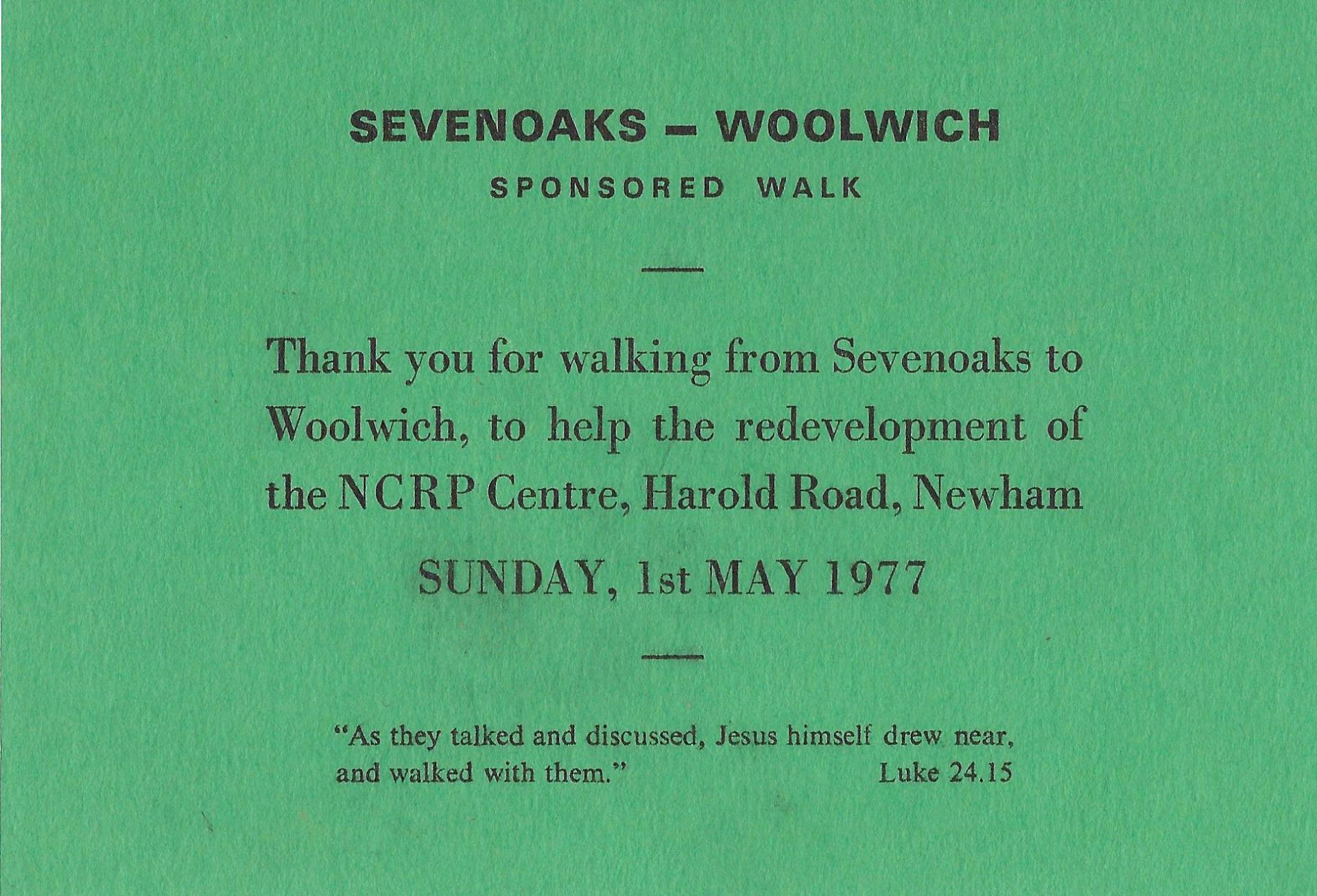
We kept records of the sale of timber, pews, scrap iron etc, and community and other donations – we even had a small gift left in the Will of one of the older supporters. Fundraising events such as Jumble Sales and Bazaars were held regularly both locally and by churches and groups further afield, who also sponsored events like walks and concerts and they in their turn also gave us ideas that we could follow up locally.
Cliff’s travels in his role as President of the Congregational Federation from 1976 – 1977 and then the extra year’s service not only took him around this country, and as a by-product gathered church support for the whole inner-city ministry, not just in this country but also from the US.
Most of the many donations we would have been receiving throughout, would have been £100 or less or similar sums in dollars. But as the new year dawned, we received a larger donation from the Moravian Union of £I,000 and then in the final days we received £15,000 from the J Arthur Rank Foundation.
This latter significant donation enabled us to spend money on curtains as well as set up the Centre for future action when the project was over.
By the end of March we were therefore able to purchase many metres of green velvet curtain fabric which a number of local ladies from the community ran up under the supervision of Mrs Fisher and we had these up in in place in time for the opening week – but more of that exciting event shortly.
The Programme is Over
We had to confess that at some times it had been a struggle – not just for us – but changing people’s attitudes to adjust positively to new situations and new social cultures. We also shared in the challenges that others in the local community would continue to face.
It had been a struggle to complete the project on time, to carry out the finishing touches, clearing up, replanning, and reopening the Centre, finding jobs for all those who had been though the process and enabled it to happen and also involving them in the future use of the centre.
At first this had been a means to an end, so that we had better buildings more quickly, and then we were concerned to tie up the ends so we could complete it before we needed to leave the area, but gradually the whole project had even more significance and became very much more important. We were now using unemployed young people, like the rubbish that other people didn’t want, they all came to us feeling unwanted. Of course, the job did take longer than originally planned and it had needed an extension in time with no increase in funding, and some young people we employed did cause us more work than they achieved. Nevertheless, it was completed to the satisfaction of the MSC and in the end we all gave sighs of relief and had the sense of a good job done. I am sure that others too breathed a sigh of relief that I was still able to carry the paperwork through beyond that date!
A Learning Experience
I have no doubt at all that the whole job could have been completed in a much shorter period of time and more efficiently if we had had an expert team of builders, but this was a very worthwhile project. It was a learning experience for all the boys, for me, for the community, and for our team.
We took great pains to instill commitment to the project and to what they were attempting to do with us, so that each young unemployed person had a sense of purpose, and at the end, a sense of personal achievement which was our original purpose in undertaking this as a community development project.
There was much more going on though than we have reported in this abbreviated summary during this period of time. In Appendix A we have included some of the further stories and experiences from the boys. To know more about actual stories from the boys involved in this eighteen-month development go directly there where you can read more about the stimulation to produce this piece of history 50 years later and all that we learned during this time followed by our conclusions and where to find more of all that had happened.
But before we look at this further, the next chapter carries on the story of the Centre inasmuch as we can tell with our continuing records. We will return to the Harold Road local community project – how this new build affected the whole community. How they celebrated their new premises - and what was happening at Harold Road and with the Renewal Programme in the immediate future.
Sadly, much of this will no longer be first hand but gathered from reports as although Cliff and I had moved into Newham thinking that we would be living in the East End of London for the rest of our lives, this was not to be – change was in the air and in the end even those changes turned out rather differently than expected - but now going forward on this project needs to be supplemented as although somewhat reluctantly in many ways we did hand on this part of our lives to others to carry forward
By the end of July 1978 we had also completed other personal plans for the future and were moving home to the other end of the country and taking on fresh challenges of a more national nature.