Chapter 6
When the news came through 5 weeks into the new year of 1977, when we had almost given up hope, everybody welcomed it with joy and the news spread like wildfire throughout the community. We would need to commence within the next five weeks – ie by the end of March - which did not seem long enough to complete our plans and get started but we set to work with fresh heart and vigour.
During the first few months of the building project, although the Playgroup now theoretically had the use of the upstairs room that had been created from the space behind the pulpit, they continued to meet in the downstairs hall. This was mainly a joint decision because the upper gallery rooms in the church alongside this newly created extra room, were to be prepared to become a community workshop and the bridge at that level was still being created. This was now expected to be one of the first jobs to be carried out by the Job Creation team as early as possible so that the job could be seen as a whole.
Once this was agreed the House committee and various sub-committee also took further heart and the church groups made significant long-term plans that only they could make – like registering for marriages in the Moravian tradition!
Our Job Creation Programme Starts
In those five weeks we did manage to complete and activate all our planning arrangements, and then carried out interviews in the week beginning 21st March. On the 28th March 1977, we employed our first two foremen. Having quickly established the right relationships with them and ensured that the area was fully operational as a building site, the next day two labourers joined them in order to get stage 1 under way which included not only the small community rooms at gallery level, but also access to the adjoining community hall at both levels and the construction of storage areas - knowing that we would need to complete all our plans within 45 weeks – that is by the last week in January 1978.
When the programme became fully active within the next couple of weeks, we needed to open yet another bank account for everything to run smoothly, but in this way both the grant being made for labour and the additional costs which were now kept separately, could both be managed by the Borough Finance Department as I agreed them.
Management and Support
We were very fortunate with all the other supporting help we needed by continuing to be part of the Renewal Programme at Harold Road. Not only did I continue to have a significant role in the training programmes but also in the interviews for the TCW vacancies and their placements in community projects. Greg was committed to the area long-term and was carrying out research among the Asian community and Urban Mission. He was already living in Harold Road so I had no worries about the on-going. Community Centre itself and everything was flowing well. And, of course, now we had ‘H’, although not yet an employee or an acknowledged TCW, he had been officially seconded to us as a volunteer by the Renewal Programme so that he could use his building skills to assist this project on the technical side
‘H’s role proved to be invaluable not only for ensuring the right materials and the best firms to be used for hiring the right equipment at the right time (as we had nothing and very little materials funding as yet) but also to ensure that the best techniques were being used and linking us with others in the building trade.
Although ‘H’ had not been involved in converting the Organ loft, he had become an extremely important link by being a constantly available person who could act between management and workforce in addition to this new development. For me, he was especially valuable as I was still carrying other roles inside and outside the centre. He became so involved that we began to realise that cum the Autumn, he would be missing out on the wider experience being offered in other dimensions and other projects and it was not long before we determined to do something to remedy this when the opportunity arose.
Delegation of Responsibilities
From the beginning, we built up a team of four to carry the practical coordination and leadership of the project. There were two specific complimentary roles needed – ‘H’ and myself were there as sponsors (both ostensibly volunteers) and two recruited foremen through the MSC programme (employed on Government terms – ie from the longer unemployment register). We each had this building project in common and easily fell into a routine of meeting every fortnight on Wednesday afternoons for a combined planning meeting. The titles we used, and the definition of our roles, may have developed over the period of the whole project but this small group of four served us well throughout the project. ‘H’ and I bridged the gap with the community: we were also able to call upon the Renewal Programme for further more specific support for specifically Christian outreach work or personnel pastoral support, whenever it was needed as the Job Creation Programme would make no provision for any of this. Over the time the project ran, it became increasingly apparent that further support would be necessary if we were to follow up particularly any specific pastoral problems with a number of the boys – Herbie Boudier was specifically appointed by the NCRP to carry out this role during that year and also to head up any outreach and evangelism with Greg and the community. But he did not get involved in the actual building redevelopment itself or the teams that developed – no kind of any support, pastoral or other, had any place in the Manpower Services co-operative arrangements so it was carried out with and by the Renewal Programme if and whenever it was needed. An excellent partnership!
Evangelistic Outreach
The Renewal Programme had built and crossed multi-cultural bridges and the community at Harold Road did have Christianity at its roots. Many churches who had been financially supportive of the work from outside the area were also keen to be involved in sharing the gospel. The New Life Singers from the States on an overseas tour had brought an exciting dimension to Wakefield Street but they also visited the Harold Road community as did Lea Abbey1 and Scargill House with their teams and some local help from their ‘In Contact’ team. Wesley College Bristol training student Methodist ministers carried out a full week’s mission in the area and of course Christian Bible and Theological colleges were sending placements. Many too were planning to cooperate further with evangelistic missions.
In 1977, the year after Cliff had been President of the Congregational Federation and we had been in the US that summer celebrating that nation’s bicentenary, he had been drawn back in for a further year of country-wide travelling as his successor had died before taking office. During this time the International Congregational Fellowship met in July in the UK. NCRP members put together a great musical celebration 'And the Glory….’ for their closing United Rally in Westminster Chapel which was also well attended by all sections of the Harold Road community who had opened their homes to these international visitors and had made many more new friends.
But back now to the actual Building Development programme.
Planning Staged Work
Alongside an existing upgrade to the community facilities in the adjoining hall, for ease of operation we had planned for five distinct stages for working on the derelict building. Below are the five stages although it did not always quite work out this way and some of the stages overlapped:
1. Construction of small Community Rooms at gallery level with access from adjoining hall plus construction of storage areas.
2. Erection of the new entrance from Harold Road and conversion of open Plan Coffee Bar Area off the new entrance.
3. Restoration and general facelifts to the main structure of the building.
4. Erection of new toilet block
5. Finally, preparation of large hall downstairs for community use.
Getting Started
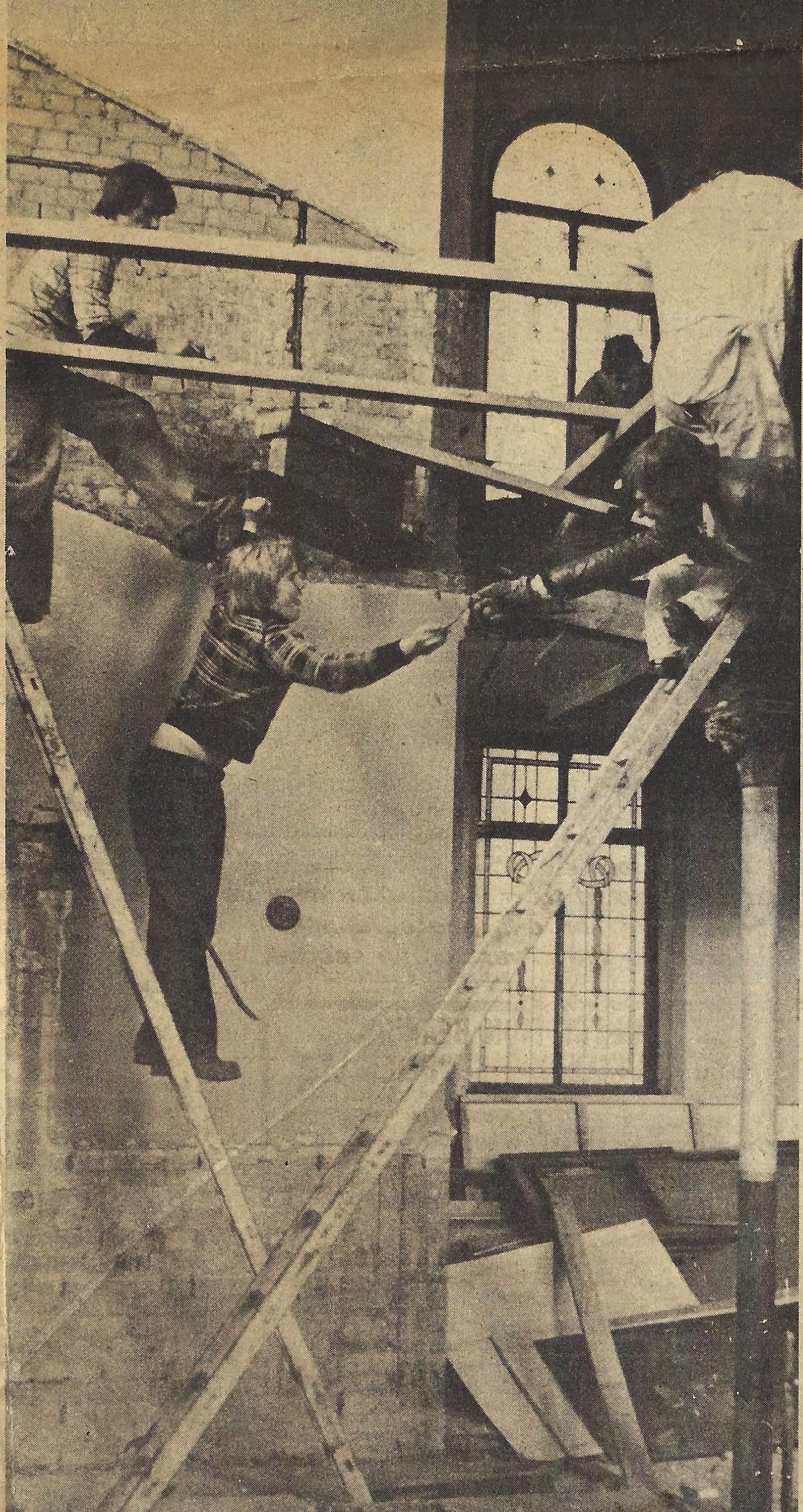
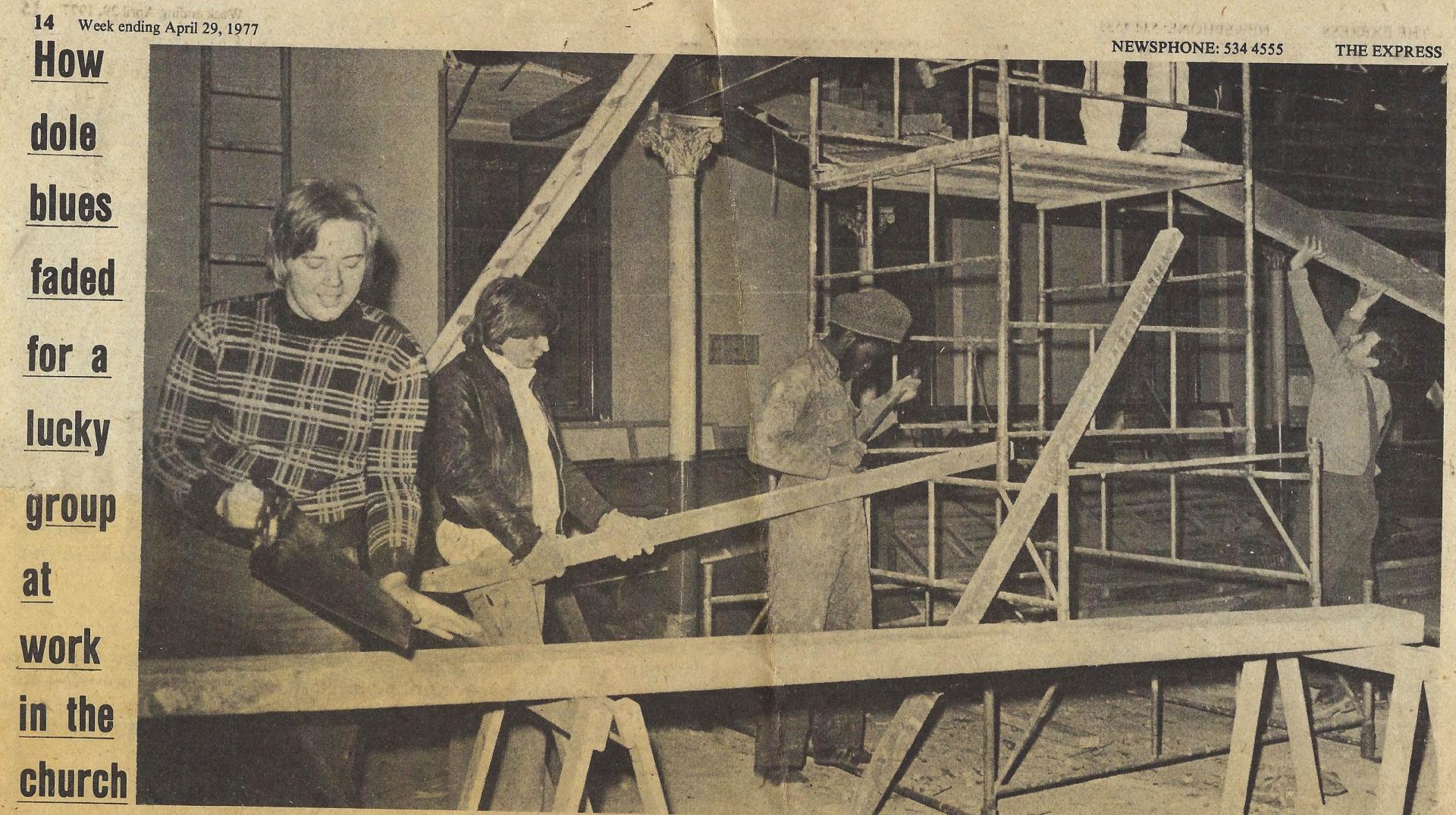
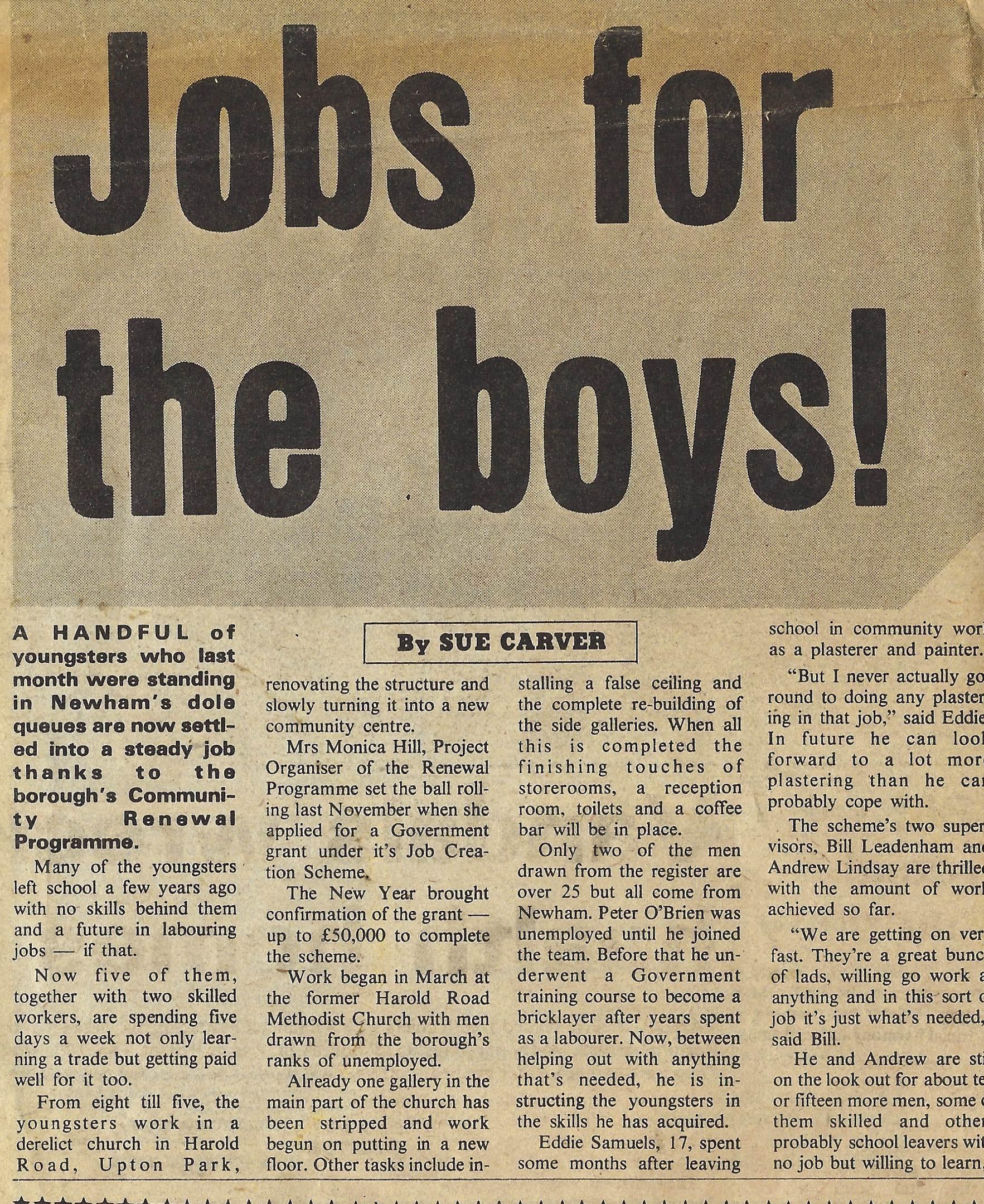
On the 28th March 1977, we had started small, but the team gradually grew, mostly with enthusiastic young labourers who set about clearing the galleries and the church space. We had had two shortened weeks over the Easter period and then in the following week ending 29 April we had a huge piece of publicity from the local newspaper who had been taking a great interest in the project. By that time, we had a group of 7 or 8 including our first craftsman (a bricklayer) who was helping to create the storage rooms plus partitioning, studding and repairs to the Community rooms above the hall for the Renewal Programme. The local newspaper had given us good coverage although I remember feeling very concerned at the photo they took and published: this showed two long ladders crossing each other in the large now rather-less-cluttered space inside the church itself which was not quite as dangerous as it might have looked.
From that time on, we seemed to be for ever interviewing new young men (never being sent women until nearing the end of the project), collecting paperwork and ensuring we were keeping the right kind of records. We had outdoor work going on at the same time as working inside.
Measuring Success
Although not everyone we took on actually turned up for work, even so we soon reached double figures, although in those early days we also had to release one young man who had very quickly got a better post – this also disrupted the progressive flow of the work as we needed to find a replacement for a good worker. But we needed to accept that this was being used as one way of measuring our success rate!
But there were also various other levels of success. Although we had given a few first and second behaviour warnings to those who had no experience of the workplace (which I always made a point of following up personally with them in a discussion on the reason for these having been given), it was week 7 before we had to carry through our first dismissal – one lad was just not turning up for work and had had numerous warnings. Then in the following week another of our labourers unexpectedly left of his own accord and although we did try to find out ‘why’ we were unsuccessful – we were learning that this was not going to be easy.
Improving Existing Premises
In my wider role with the Renewal Programme, I was already using the small room upstairs to help Greg coordinate all that went on in the existing community centre as well as coordinating the training and publications. Gradually more Renewal Programme staff members were finding this area a useful central point while work continued to be carried out and then the decoration and final preparation of their intended larger staff facilities and offices along the corridor. These renovations included replacing one of the windows before the bulk of the Renewal Programme’s furniture could be carried up and set in place and they could start to benefit more fully from their new offices. The gift of the excess furniture had arrived from the Finance Offices following their move to new offices the previous year and had already being stored safely in a protected area in the church.
The more modern section of the already-being-used halls in the community facility alongside were also already receiving an additional face lift, improving the stage area in the hall, renewing cisterns, tiling and decorating in the two toilets near the hall entrance as well as sanding and varnishing the hall floor. This was all carried out by the new team of inexperienced boys and needed to be coordinated smoothly to ensure that it did not interrupt a continuing programme of community activities.
Planning Permission
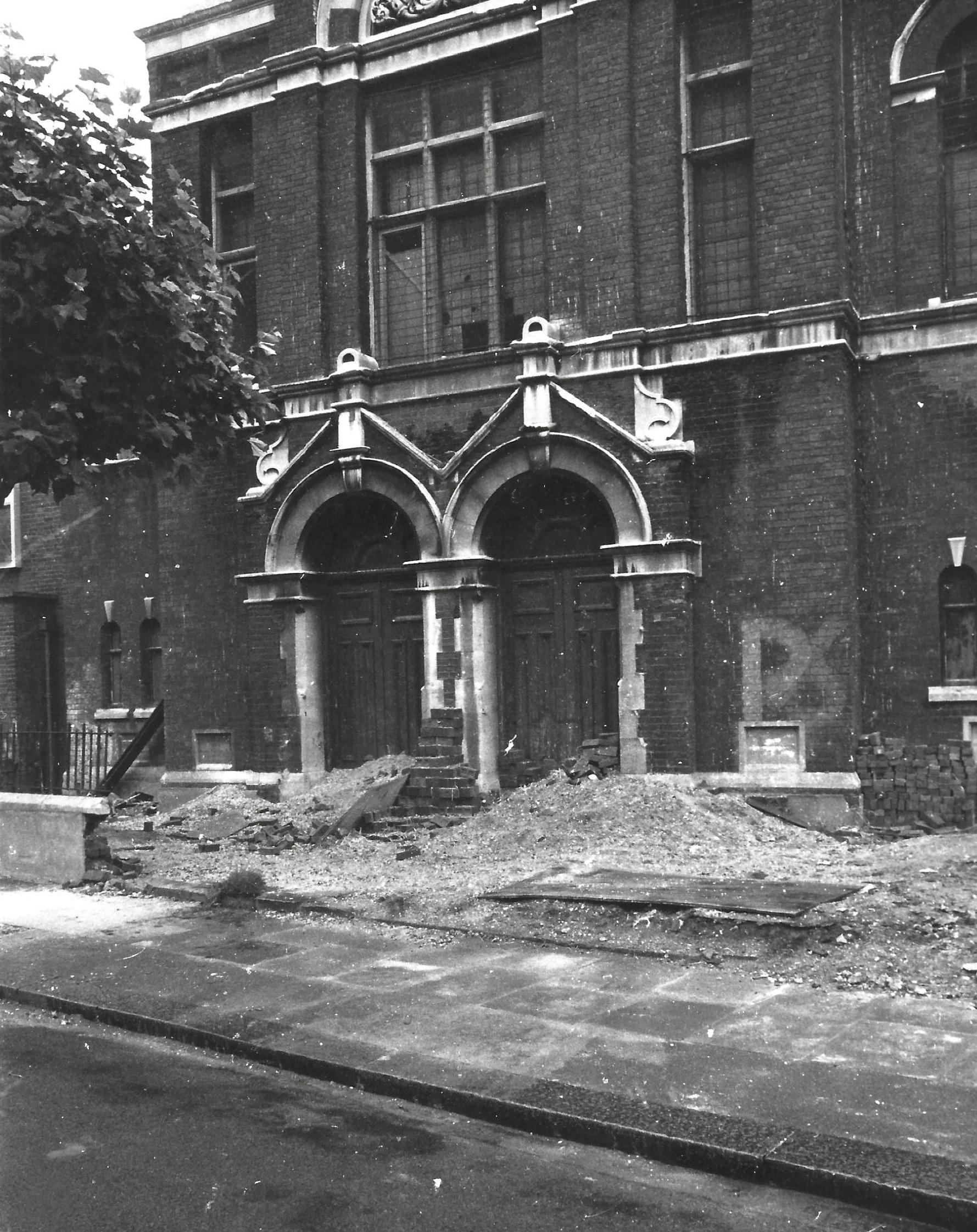
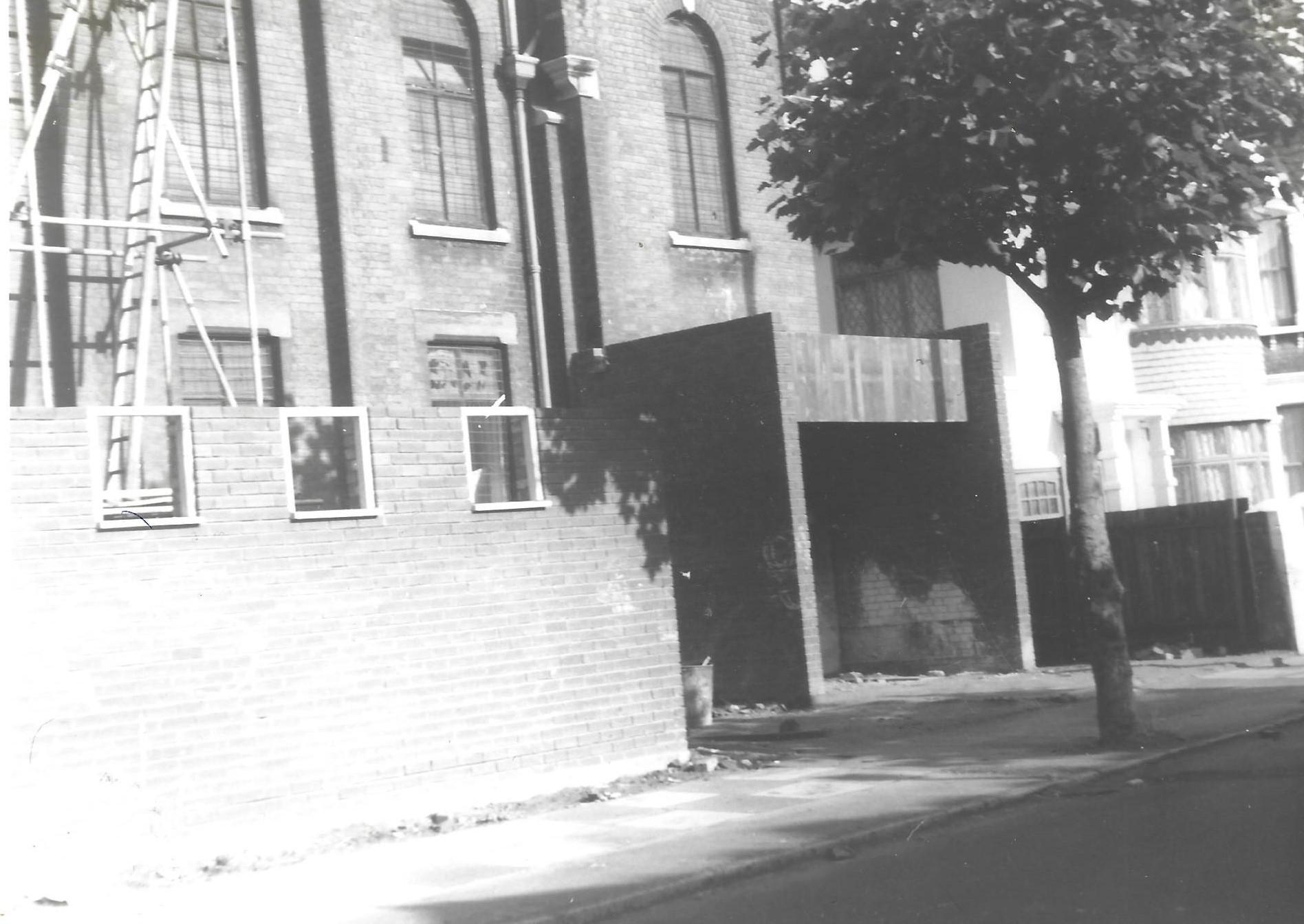
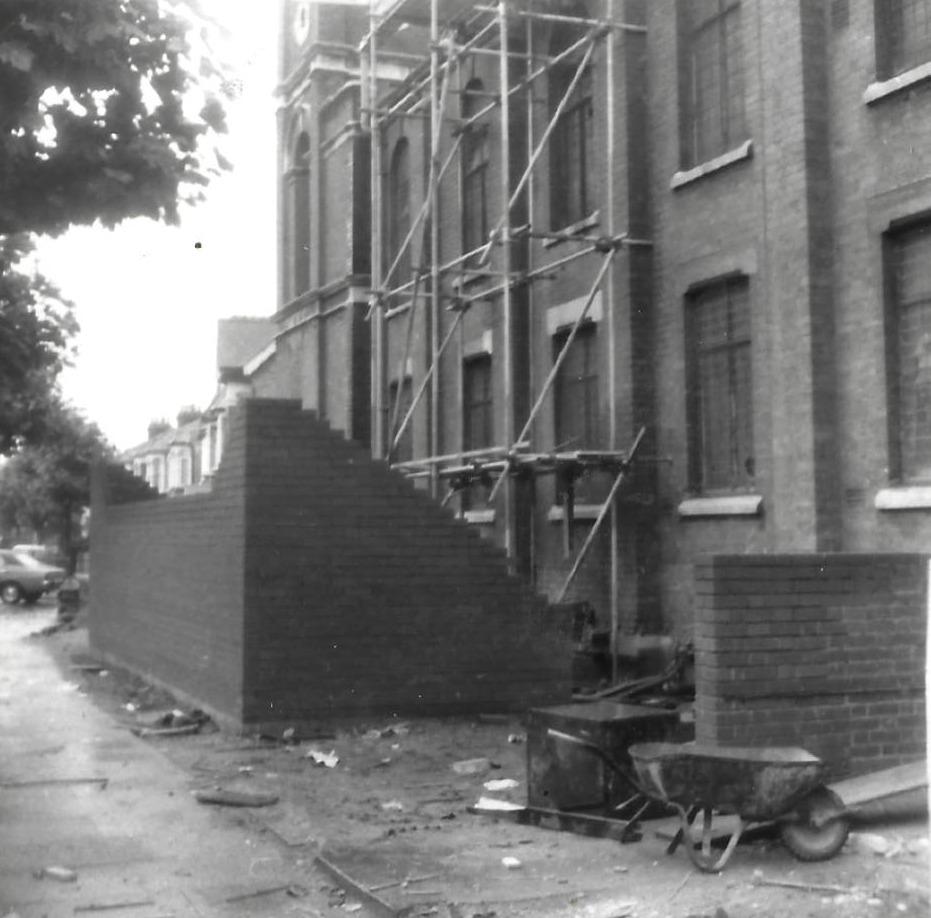
I am not quite sure how we did it, but the planning permission we had carefully designed and requested for a new external toilet block which extended well beyond the building line on the main Harold Road side of the church building, was approved . Although the weather was not good, work soon started on this new build section on digging for the drainage pipes and shifting the surplus earth to the area round the Claude Road entrance which was to be relandscaped later in the programme.
More Publicity
By the end of May we had been in action barely two months when we had TV cameras on site to film the progress to prepare a report for Parliament on Job Creation Programmes – I think this was shown in the House of Commons during a debate on youth work fairly soon afterwards and would have led to further decisions on this fledgeling programme.
By this time, we were needing to plan very carefully for each day’s work, build teams for different tasks and skills as well as to operate in different areas and we needed to keep a detailed diary of the occasional interested visitors – which included more pew enquiries as these were now selling at £20 each or two for £30 - buyer collect.
We found that particularly when we started outside work, renewing the entrance and working on the outside walls and roof, we also attracted a number of different inspectors, invited or unexpected, factory and building, from advisers on water, dry rot, fire prevention, to inspectors on building regs etc – some seemed to be coming in regularly each week.
Incidentally, my small, shared office at the top of the stairs in the hall section had also become a natural gathering point for first-time visitors to the area, where a fuller overview of this restoration in the context of the wider work of the Renewal Programme could also be explained prior to the main offices being completed. It was here, earlier, during Spring 1976, we had had one such visitor, almost incognito, but exploring possibilities of an even wider national vision of what we were doing. This first visit by Canon John Poulton, and his subsequent visits, certainly were to have a major effect upon us personally, as well as on the Harold Road Building Programme and the future direction of the Renewal Programme and its various projects - but I digress, more of that later in this book and others.
Expanding work
In the last week in May (week 9) when those who had been with us for some time, were taking some of their holiday already due, we carried out seven further interviews and three more young labourers were due to start the following week bringing the numbers on our payroll to over 16 for the first time.
By this time landscaping had begun at the front of the building using the soil from the toilet footings. Although we had planned for a new Noticeboard to be erected as the rebuild programme concluded, this was an additional item which had not received detailed planning so although we all rapidly agreed that a crazy paving area would look good, we knew we had no budget for paving stones!
Making Use of Unneeded Resources
We had our eyes on all that was happening around us and had noticed that the Council were currently renewing the pavements a couple of streets away, and on enquiry they allowed us to collect and use any of their broken paving stones as long as we picked them up outside of working hours. I have memories of around ten of the NCRP staff and volunteers, including Ardil in her sari, collecting these at 7 am one morning when some of the early workmen had started to come on site. When they knew what we were doing there, they were so impressed to see ‘white collar workers’ out so early picking up stones, some not only lent a hand, but a few more paving stones may have become broken deliberately to assist us – creating us with a moral dilemma! These stones also did make the outside look more like a building site until we could get round to laying them properly towards the end of the project.
Goodwill Cooperation
Although the Council were still our main supporting supplier in issues like this, there were also many others who were willing to assist us in providing for all our needs. In addition, I was keeping an eye open for opportunities (having been given an unofficial title of ‘chief scrounger’ by the Renewal Programme, I think (and hope) quite affectionately) and fortunately other individuals, churches and groups began offering us materials.
One gift came from Dulux who were offering paint nationally for community projects like ours - but they ran out too quickly. When I requested being kept on their books for when they made further offers, they asked if I would be interested in an insurance claim for paint from a road accident which had ‘fallen off the back of a lorry’. This term had a different meaning locally but did seem quite appropriate for the area! It was mainly in large cans of orange and purple - both popular colours at that time - which is why the coffee bar was originally painted in these colours!
These cans were undamaged from their fall but needed to be collected from Dagenham. I enquired about quantities and took ‘Percy’, one of the boys and drove my mini down to pick them up. ‘Percy’ loaded the mini while I was inside talking to the Dulux member of staff – but the workmen on that site were over generous so when I came out the mini was filled with cans of paint to the roof and ‘Percy’ was standing there mortified as the suspension had given way and the chassis of the Mini was flat on the ground – quite immoveable. I dreaded the worst, but the AA came to the rescue and after we had unloaded it, they got my precious mini to a local garage who just re-inflated its suspension for me and it ran again as good as new. And I am glad to say that we also did not miss out on the extra paint as a colleague drove down to share in transporting this ‘too-good-to-lose’ offer back to the Harold Road site.
Scaffolding Miracle
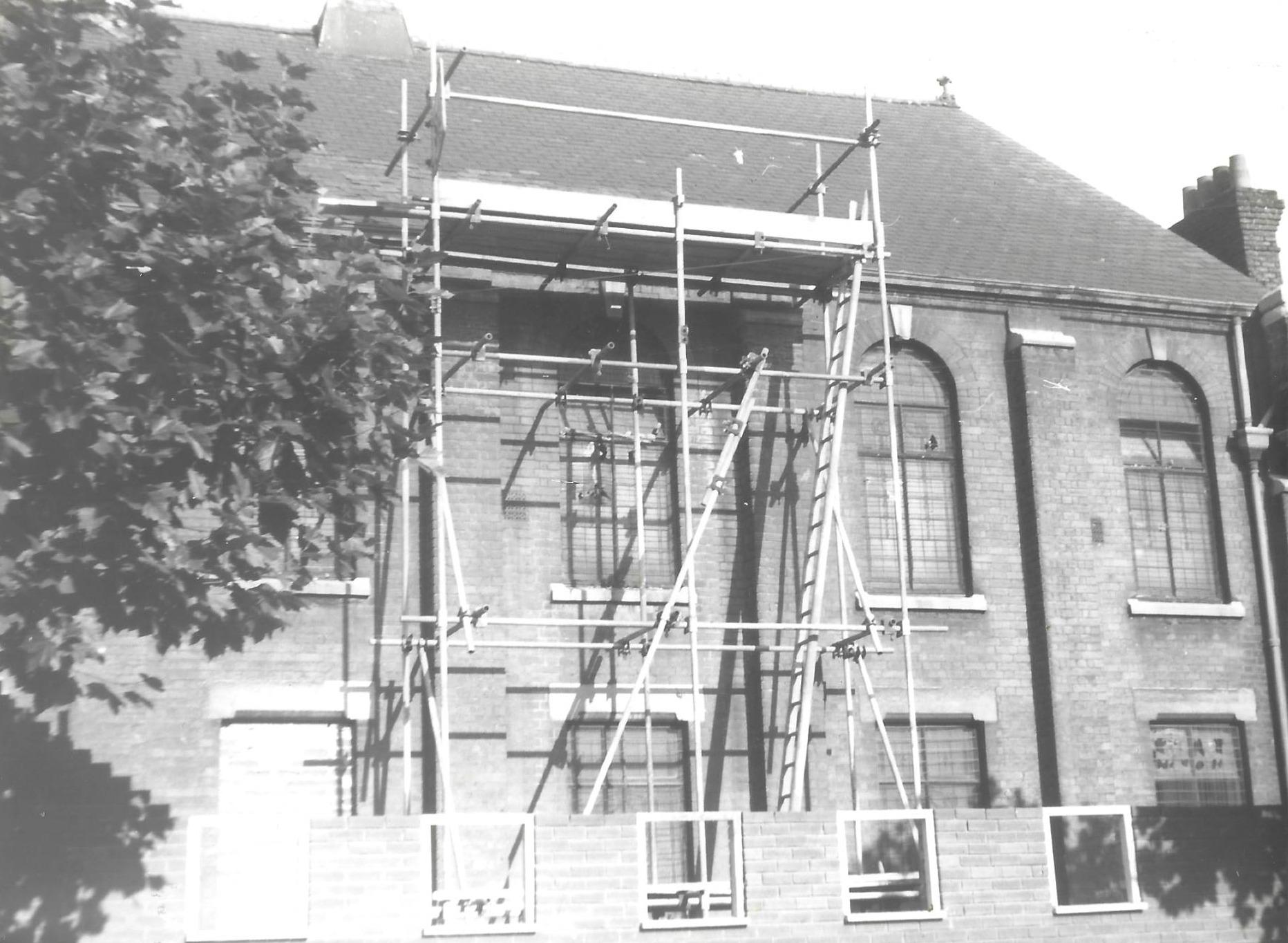
We had many times when we praised and thanked God for watching over us in other different ways and guiding our actions. A local church had loaned us their indoor scaffolding tower for any internal work, but we did need to hire a larger outdoor structure before we could start work on the upper outside reaches and the roof – not just of the church building but also of the adjoining hall which had a flat roof. This had been scheduled to be done in the summer months of 1977 but we were let down by a local scaffolding firm at the last minute.
When the scaffolding did not arrive, we had started ringing round all the other scaffolding firms in the area with no success and it was nearing the end of the working day. Szerelmey, although south of the river, was next on the list although thought to be more than likely out of our price range. I rang the number but there was no response until suddenly the phone was picked up and a rather tired-sounding older man answered the phone. I realised that it was now gone 5 o’clock and the office would probably already have closed. I apologised and explained our predicament and this well-spoken man at the other end began to show an interest and said he would see what he could do the next morning. It was only later that I discovered I had spoken to the owner himself who subsequently pulled out all the stops and we had the scaffolding up within days at a price we could afford and the work started escalating again.
But the roof repairs were not without their ‘squirm’ moments. These were not so much from the work itself – but from the boys carrying it out. One or two rather enjoyed being up at that height on the hall flat roof and felt no necessity to come down to relieve themselves, and I started to get complaints from the neighbours of ‘unacceptable behaviour’ and the reputation of the project went down some points in the eyes of some of the locals and these stories spread like wildfire.
Suspended Ceiling Challenge
We were still operating with JCP labour at the start of 1978 but nearing the end of the project and needed more professional help to give the still lofty chapel and ground floor area an enclosed feeling which would retain some of the heat generated. Our research had found a firm who would install an Armstrong Suspension ceiling in just 2 weeks for £500 by using our labour and supervision. A recently qualified Christian chartered consulting engineer2 with his own practice in the neighbouring borough of Walthamstow, felt sure that he could provide us with an equally good, and even better, suspended ceiling using the newly invented and readily accessible tinfoil for a fraction of the cost, and he wanted to supervise this. The fact that our funds were low, and the development funding did not cover consultants’ fees, did not seem to deter him as he was prepared to give his consultancy advice as well as his supervision free. When his research hours began to mount up, we wanted to give him an honorarium based on the hours he had put in and we agreed a nominal £1 an hour with his firm buying in all the materials. As it was a relatedly new concept and there was a delay in obtaining some materials, the ceiling was not actually completed by the boys until after the Opening week, but its effects would not be felt until the Autumn anyway. Even so everybody was delighted with the result with many good comments and a feeling of good will all round.
Community Clash
Not everything though had gone smoothly, all the time. We had had a community clash in the early days when we had had to counter some early racial problems, not so much with the Afro Caribbean immigrants who had been around longer, but with the Asian Old Men’s Club when it was formed and started to meet on Thursday afternoons. This was not from members of the Centre who were welcoming the newcomers, but with the boys from the local school where ‘Pakibashing’ seemed to be fair game for some of the older boys - especially with this group who did not understand or speak the language. We had to ensure that we had burly staff members around, or that the group finished early so that the vulnerable members could be back home before the schools came out.
Then the arrival of the Job Creation Team brought other problems for the Thursday afternoon Asian old men and this particular group became the target of abuse when others weren’t looking or listening. Not many of them spoke English, but they were very willing to be friendly to all who would be friendly to them. I remember going past the communal kitchen where they were preparing their tea and a couple of our lads were also there too preparing tea for the workers on the site, and hearing them saying to the Asian old men, in very friendly tones, “Up the National Front eh!” “Good group - the National Front”. Two older Asian men preparing their tea at the same time were grinning happily and nodding their heads in agreement and saying ‘Yes! Yes!’.
It didn’t just stop at this kind of ‘Pakibaiting’. Steps had to be taken when Polyfilla was mixed in their kettle and when paint was daubed on clothes and when stones were thrown when the old men were leaving the meeting. On their own, I do not believe that any one of the boys would have behaved in such a manner, but as a group they egged each other on and in order to survive with their mates, they felt they had to be seen to be carrying it out.
Racial incidents
Although racial conflict, where possible was kept to a minimum on the building site with only the occasional flare up, I also recall ‘Jamie’ who was big and strong and in the two weeks he was with us he was always challenging other workmen to go outside to fight. He didn’t last long with the team on the site, but he did not live too far away, so we often saw him in the days ahead. We saw him once with a great bandage over his eye and he was bragging that he had been down to Lewisham when the National Front and the International Socialists had had their rallies at the same time, and he had been in the big punch-up where he had lost an eye. He obviously gained some kudos from the younger lads who came out to chat to him, but the older and more sensible shook their heads and wondered when he would grow up. As things turned out he had not lost an eye, although I have no doubt that he was involved in the Lewisham riots, although which side he was fighting for we did not know. I don’t think it mattered to him.
I think, after leaving us, ‘Jamie’ must have found a role for a time with his family firm of ‘rag and bone’ men’. Their collecting transport could still be heard fairly regularly going up and down the streets calling out their wares - Steptoe and Son style. One day in August, when I happened to be in the upstairs community room catching up on paperwork, their transport stopped outside, and I looked out of the window and saw ‘Jamie’ going into the church building. Warning bells rang as we had recently been taking out, and storing, some of the stained-glass windows from areas which were to be storage rooms and had stacked them for further use under the gallery stairs near the front door. I rushed down and was no doubt just in time to stop a daylight theft involving other young workers who blithely claimed that ‘they thought we would be pleased’ to be rid of them!!
Foreman Change and Unrest
When we had been operating for some four months, the team had been gelling well and we were getting used to operating as a working foursome with two foremen sharing on-site responsibility and ‘H’ and I on call. Then in mid-July, ‘Alex', our younger 21-year-old Works Supervisor announced that he would be leaving us to emigrate to start a new life in Canada which coincided with some unrest among the growing number of labourers and trainees. Petty vandalism seemed to be on the increase and there were some problems at that time with football at lunchtime resulting in the need for restoration of community relationships following a couple of broken windows,
We realised that the possibility of only having one on-site foreman would not be enough to keep an eye on everybody on such a wide site and even ‘Ben’ who had been with us from the beginning, began to waver when on his own. One of the new intake had had to be dismissed for severe misconduct and two of those who had been with us rather longer were given their final warnings – pressure was rising.
[1] Greg has memories of making friends who then came to live and join in long-term
[2] He had an interest in supporting Workers Initiatives and was already involved with other sectors of the Renewal Programme particularly in the Beckton area initiating a section for the unemployed there with Jon Baston and John Widdowson.
- 1. Greg has memories of making friends who then came to live and join in long-term
- 2. He had an interest in supporting Workers Initiatives and was already involved with other sectors of the Renewal Programme particularly in the Beckton area initiating a section for the unemployed there with Jon Baston and John Widdowson.